
Everyone's been saying that AI will soon do any job. AGI is coming to take our careers and replace entire industries.
BUT, this superintelligent AI can't even reliably buy me a bag of coffee? How weird is that?
This is the order we're being told AGI happens.
- First AI replaces programmers
- Then analysts.
- And everyone else.
- Then, somewhere along the way... it'll figure out how to buy toothpaste.
But that makes absolutely no sense. Shopping is one of the most basic, repetitive, low-skill things humans do. We teach children how to do it.
And it's not like nobody's trying. Everyone important has placed their bet.
Stripe, OpenAI, Mastercard, Visa, Google, Coinbase, and more. MPP, UCP, x402, and the list keeps going on. Billions of dollars invested, thousands of the smartest engineers alive, and all pointing at the same bet.
(References at the bottom if you want to dive down the rabbit hole.)
So… people are probably using this stuff. Right?
No. Almost nobody on the planet lets an agent buy anything for them.
What do people actually do with AI assistants anyways? Look:
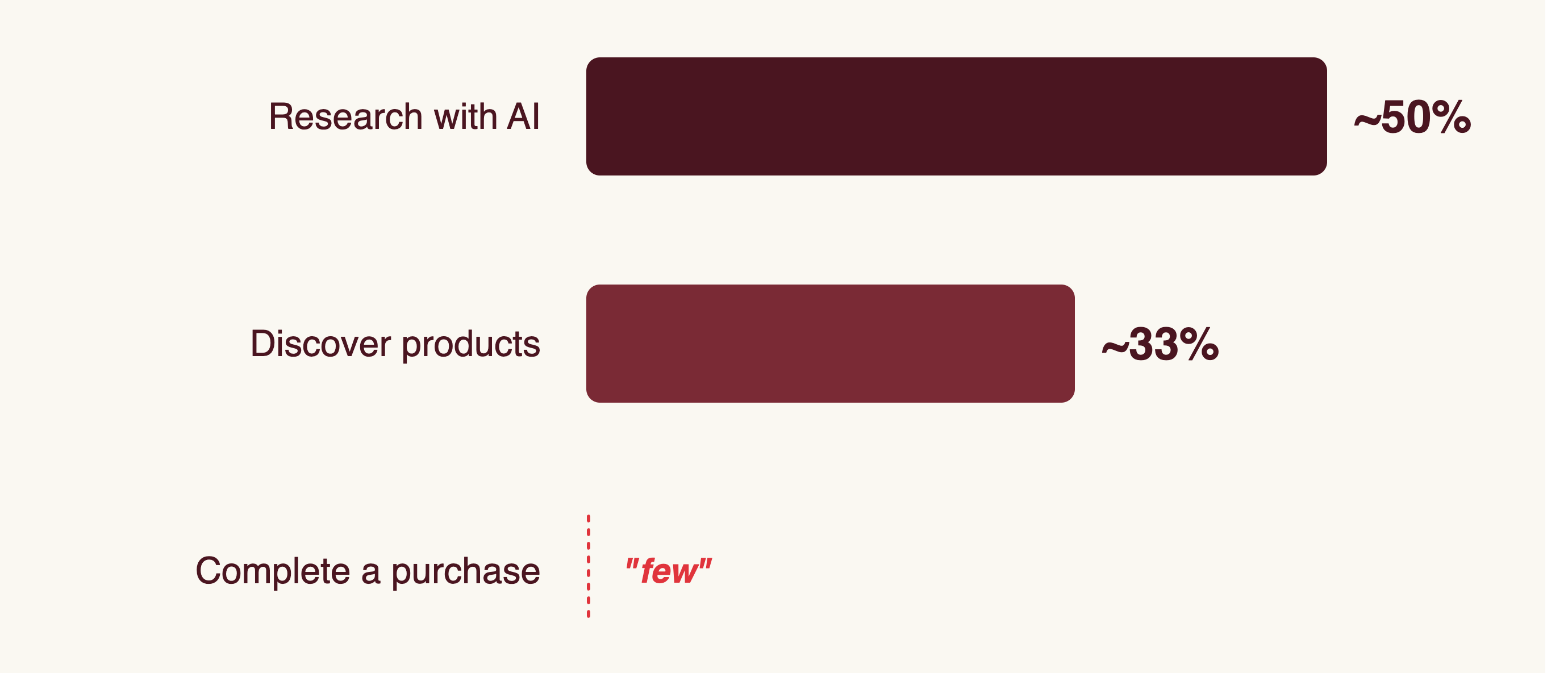
Sources in the References below.
The tech and the behavior are moving in completely opposite directions. Forrester ran the numbers, and "complete a purchase inside an AI assistant" came dead last among things people actually do with these tools.
And honestly, if anyone was supposed to close it, it was OpenAI.
Think about what they had. The best models on earth. Almost a billion weekly active users. Shopify. Etsy. They built checkout directly into a chatbot, you see the mug, you buy the mug.
Everything. Lined. Up.
And just 5 months later they killed it. People ended up asking ChatGPT what to buy… opened another tab… and then bought it themselves.
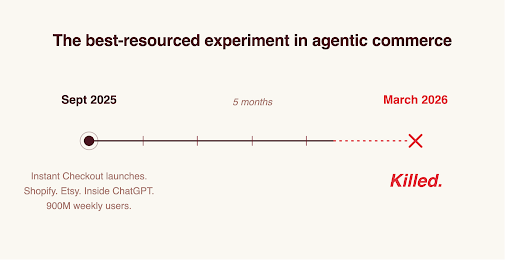
Even OpenAI couldn't brute force human behaviour.
Whenever I talk to people about this, I get one of three answers.
"The models aren't good enough."
I don't buy that. Models can navigate websites, compare products, fill carts, complete checkout.
"The payments aren't ready."
Well if that was the case, we wouldn't have the incumbents all shipping solutions within months of each other…
"It's too early."
The laziest answer. Early doesn't explain why the most resourced company in the space read its own numbers and walked away.
That's not a slow adoption curve. That's a wall.
But why?
I remember the first time I tried living with personal agents. I wasn't asking my agent to build the next billion dollar AI wrapper. I just wanted to buy something stupid.
Ice cream.
It got surprisingly far too. Found the right flavour. Right size. Right price.
Now what? A checkout page for a store I use just once. Type my name, my address, my card. Make an account. Or, paste my card details into chat. Nah.
That feeling has bothered me for a long time now, and here's where I've landed.
We've all been asking the wrong question. Everyone keeps asking, "When will AI be able to buy things?"
But, "Why would anyone let it?"
Let's look at what people already trust AI with, and let's look at what AI is not yet trusted to do:
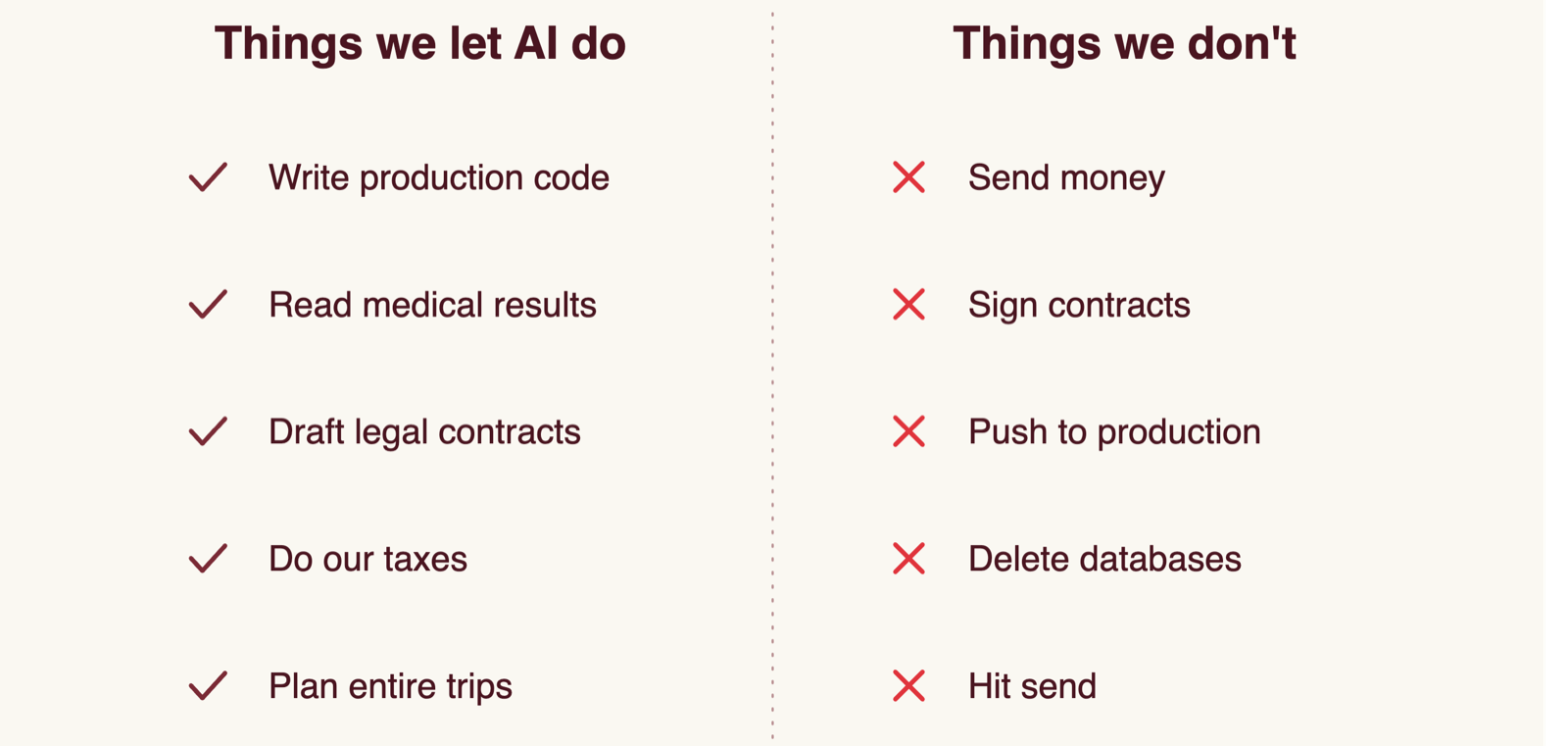
See any similarities?
None of these are harder for us. They're just irreversible.
Everything we happily hand to AI, we can undo. Bad itinerary? Change it. Mediocre code? Review it.
But payments. Once it leaves your account, it's gone. And that unsettles people.
So we already trust AI with our thoughts.
We just don't trust it with the consequences.
But go one level deeper with me.
I trust my Roomba completely, I could not care less how it vacuums, just that it gets the job done. I trust autopilot (more or less) to drive in a lane. The objectives in both scenarios are explicit, and someone's already decided what should happen.
Now imagine asking an agent to buy your mum a birthday present.
Not suggest one.
Buy one.
Without asking you.
The interesting part is that it has to understand you. Her. What last year's gift was. What she'd pretend to like.
There's no correct answer to execute toward. There's only what you would have chosen.
Everyone's building agentic commerce like it's a checkout problem. But I'm sure it's a judgement problem.
And handing over judgement isn't strange. Parents buy for their kids. Assistants book flights without asking. But ask someone, why not let an agent buy something for you?
The objection is not "I don't want someone buying things for me."
It's "I don't want you buying things for me."
You're not trusting the payment. You're trusting the judgement.
Think about how few companies have ever earned that.
Amazon. Apple. Costco, somehow. Your bank.
That's... basically the list.
Think about what Apple has accomplished. Hundreds of millions of people voluntarily hand them their credit card. They unlock their phone, tap a terminal, and don't think about it for a single second.
That's insane.
Recently Apple announced the new Siri too. AI that reads across your messages, emails, photos, wallet history, and acts on your behalf across your apps. Possibly the most intimate access any AI could have to you. And the general reaction?
"Finally"
Now ask someone if they'd let an AI agent re-order their groceries. Watch them hesitate.
"What if it buys the wrong thing?"
"What if it just... keeps spending?"
Here's the funny part: almost none of those fears are unique to AI. Apple Pay can fail. Amazon has had its leaks. Bank apps get breached. All of this has happened before!
We just don't think about it anymore. Agents haven't earned this yet.
And here's a question that took me embarrassingly long to ask.
When an agent buys the wrong thing... who owns the mistake?
OpenAI? Visa? The merchant? The model? You?
Nobody knows.
How strange is that? Every act of delegation always has someone on the other end of it. You trust your assistant because your assistant is accountable. You trust Amazon because there's a refund button and a human behind it somewhere.
Delegation doesn't run on capability. It runs on having someone to catch you, which agents don't have.
It's not that Amazon got it perfect. Half the first page is sponsored and discounted items. But what did they get right then?
Amazon made being wrong cheap.
Not by recommending better products.
Not by building a better search engine.
By changing what happened after it was wrong.
Everyone says Amazon earned trust. I don't think that's quite it.
Trust says: "I firmly believe you'll be right."
But when you buy something on Amazon, that's not how you feel. It is more like "Even if you make a mistake, I'll be okay."
That's not trust. That's forgiveness. And how did they earn that?
Free returns.
Because here's what returns actually are. They're not logistics. They're psychology. Returns kill anticipated regret.
And it has to be effortless. Imagine free returns, but only after a three-month investigation. Nobody would have trusted that.
But people tried it, something went wrong, they got their money back… no hiccups. Do that a few hundred million times and it stops being a leap of faith. It becomes a habit.
And Amazon didn't invent this trick. Chargebacks. Escrow. Buyer protection. PayPal disputes. They didn't make orders right every single time. They just made being wrong free.
Every innovation that moved real money did it by lowering the cost of being wrong. Not by raising the odds of being right.
Software figured out the same thing by the way:
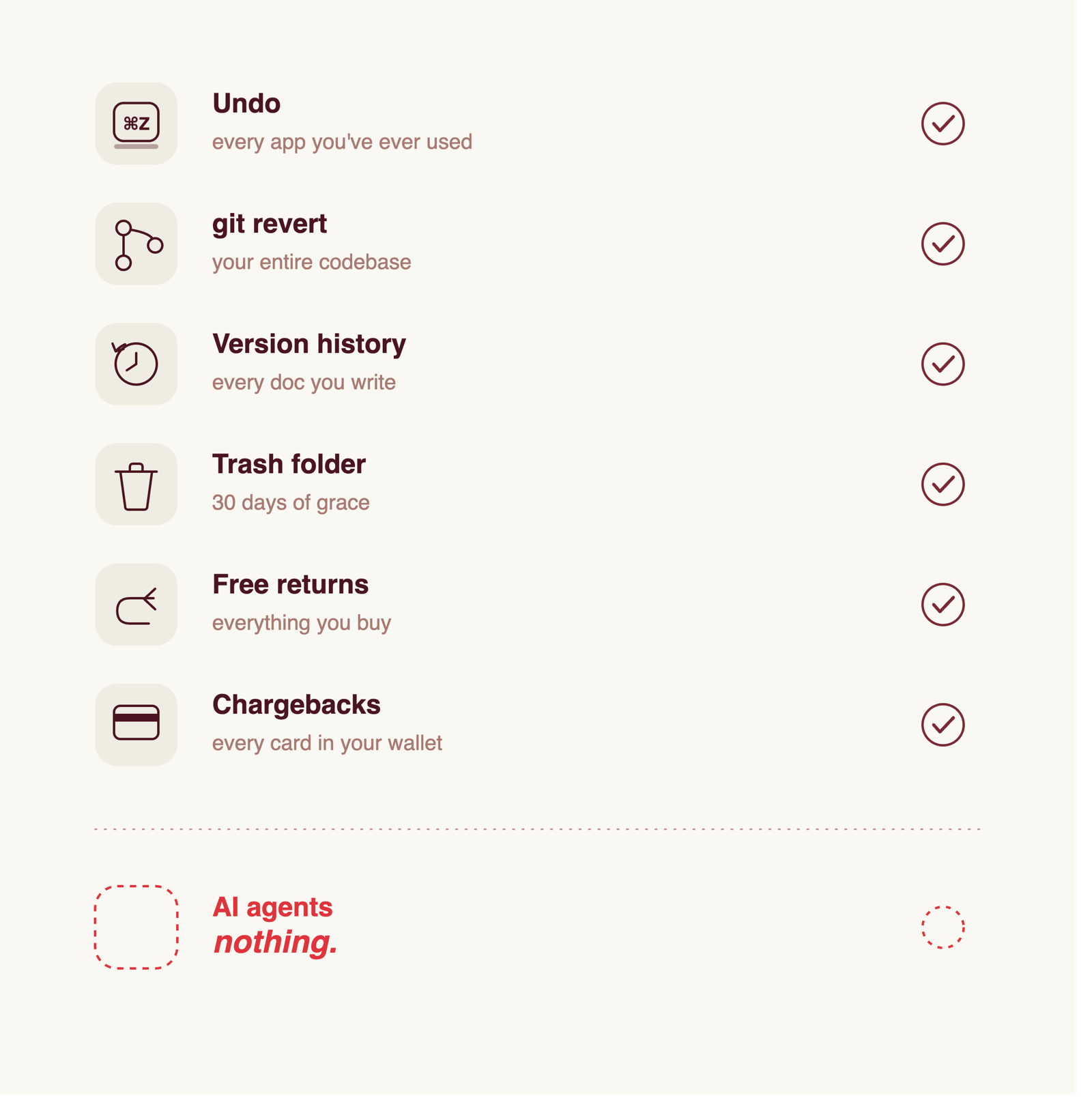
The undo button, git repos, version history, etc...
That's what Amazon built over twenty years. Not a store.
An undo button for judgement.
And nobody, and I mean really nobody, has built one for agents.
I don't think agentic commerce takes off when the models get smarter.
I think it takes off when someone invents the equivalent of free returns for autonomous decisions.
The entire industry is pointed at the wrong half of the problem. Billions on making agents better at paying. Almost nothing on what happens the first time one is wrong.
AI has earned the right to answer your questions. But it has not earned the right to spend your money.
Maybe that's why agentic commerce has felt so inevitable, yet so disappointing at exactly the same time.
One day an agent will buy someone the wrong coffee... and it won't matter. It'll be refunded before they notice. Fixed before it stings.
That's the day agentic commerce actually begins.
But before an agent can buy you the wrong thing, it has to find it. And the way agents find things today is broken in ways almost nobody talks about either.
And that's where we're going next. If you're here, just my thoughts and thanks for reading :)
References
- OpenAI's Instant Checkout shutdown — CNBC →
- Forrester, Few US Consumers Are Buying Through GenAI Answer Engines — Forrester →
The protocol rabbit hole:
- Stripe × OpenAI's ACP — stripe.com →
- Google's UCP — PYMNTS →
- Visa Intelligent Commerce — visa.com →
- Mastercard Agent Pay — mastercard.com →
- Coinbase's x402 — coinbase.com →
Originally published on X: The AI that's going to replace your jobs can't buy you coffee →